A tale of two lifestyles
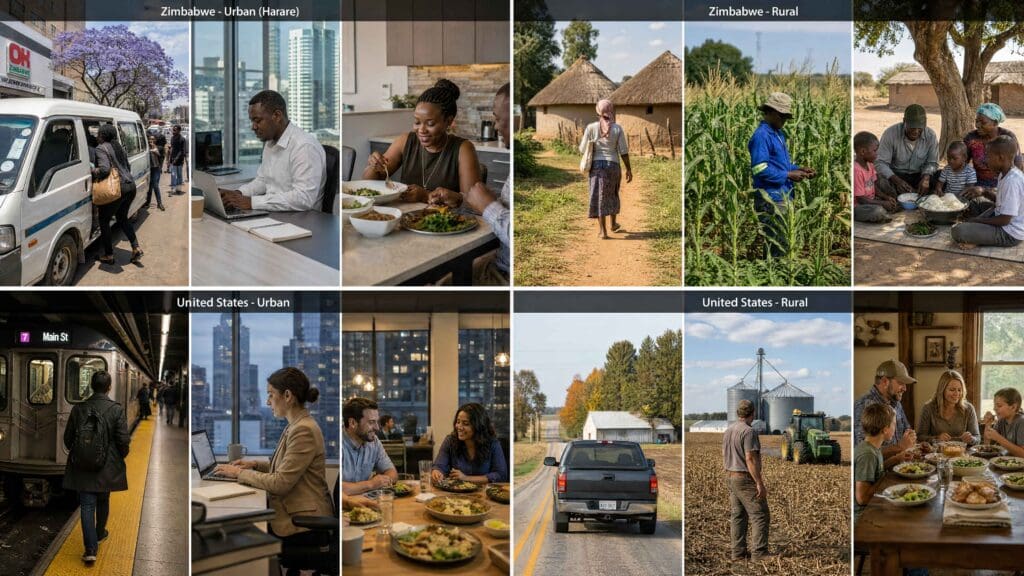
If you’ve ever wondered how drastically daily life can vary across borders, comparing Zimbabwe and the United States offers a striking illustration. These two nations are continents apart—not just geographically, but economically, culturally, and in the everyday rhythms that define existence for their residents.
Yet this isn’t a story of superiority. It’s about contrast, context, and the complex realities that shape millions of lives on opposite sides of the spectrum.
The Numbers Game: Economic Scale
The economic divide is impossible to ignore. As of 2025, Zimbabwe’s nominal GDP stands at approximately $53 billion with a per-capita output of roughly $3,070. The United States? A staggering $26 trillion in GDP, with per-capita output near $80,000.
That’s not just a difference—it’s a chasm.
Zimbabwe’s population of around 17 million navigates an economy still recovering from decades of hyperinflation and currency instability. The country currently uses a multi-currency system, including its own Zimbabwe Gold (ZWG) alongside the South African rand and US dollars. Prices can fluctuate rapidly, and purchasing power remains tight for most families.
In contrast, Americans live in a consumption-driven economy where the dollar dominates global finance. But high prices are part of that equation. The average expatriate household in the US spends about $82,600 per year, with housing alone accounting for $27,600 annually.
Daily Expenses: What Does Your Money Buy?
In Zimbabwe
- Food, housing, and transport often cost a fraction of US prices
- However, salary levels reflect this too—median monthly incomes run in the hundreds of USD for many
- Informal economies thrive, with street vendors and local markets providing affordable essentials
- Power outages and water disruptions remain common challenges in urban areas like Harare
In the USA
- Monthly housing averages $2,302 for the typical household
- Healthcare expenses add another $543 per month on average
- Annual healthcare spending per person reaches $15,474—the highest globally
- Yet median household income allows many to afford these costs (though affordability crises persist in coastal states)
Paradoxically, an American might spend more on groceries in a month than many Zimbabweans earn in a year. But the reverse is also true: some basic necessities in Zimbabwe become luxuries when wages don’t keep pace.
Healthcare and Education: Access and Quality
Zimbabwe
Once known as having one of Africa’s strongest education systems, Zimbabwe’s schools and universities now struggle with funding shortages, brain drain, and infrastructure decay. The literacy rate remains impressively high at around 90%, but quality varies widely between urban and rural areas.
Healthcare faces similar pressures. Public facilities often lack equipment, medications, and staff. Many who can afford it seek treatment in private hospitals or abroad.
USA
American healthcare is world-class in many respects, with cutting-edge medical technology and research leading globally. But access remains uneven. About 8.6 physicians graduate per 100,000 people—far below the OECD average of 15 per 100,000.
Education varies by state and district. Public universities range from $8,000–$35,000 annually, while private institutions charge $25,000–$50,000 for bachelor’s degrees. Student debt has become a generational challenge.
The irony? Despite spending the most globally on healthcare, the US ranks only 17th on the UN Human Development Index for quality of life. Zimbabwe sits at 153rd—reflecting different dimensions of human development.
Culture and Community: Different Kinds of Wealth
Zimbabwe
Zimbabweans are described worldwide for their warmth, humor, and generosity of spirit. Communal living remains central to family structures. The concept of ubuntu—”I am because we are”—shapes social interactions. Extended families often live close together or under the same roof.
Community support fills gaps that governments leave. When electricity fails, neighbors share generators. When someone falls ill, the community rallies.
USA
American culture leans individualistic. Self-reliance is celebrated, and independence is often seen as a marker of success. Nuclear families predominate, with geographic mobility separating relatives by distance.
But there’s growing recognition of isolation as a public health issue. Loneliness epidemics, declining social capital, and mental health challenges highlight the human cost of hyper-individualism.
Infrastructure and Convenience
Zimbabwe
Urban centers like Harare and Bulawayo face chronic infrastructure challenges: irregular power supply, water shortages, deteriorating road networks. Internet connectivity has improved but remains inconsistent in rural areas.
Transportation relies heavily on informal minibus taxis (kombes), which are affordable but often overcrowded and unregulated.
USA
American infrastructure is extensive but aging. Interstate highways connect coast to coast, airports offer domestic flight options to hundreds of destinations, and broadband reaches most urban areas.
Yet maintenance backlogs plague roads, bridges, and public transit systems. Many Americans depend entirely on cars—public transportation is limited outside major metropolitan areas.
Opportunities and Aspirations
Zimbabwe
Entrepreneurship thrives out of necessity. The informal sector employs a significant portion of the workforce. Agricultural potential remains untapped despite droughts and policy challenges. Tourism—Victoria Falls, wildlife safaris, Great Zimbabwe ruins—offers growth opportunities.
Emigration continues. Skilled professionals seek opportunities abroad, creating a diaspora that sends remittances home—a lifeline for many families.
USA
Economic mobility remains a contested promise. While opportunity exists at scale, studies show wealth inequality has widened significantly. The Gini coefficient indicates moderate-high inequality, though lower than Zimbabwe’s.
Tech innovation, entertainment industries, finance, and higher education drive economic dynamism. But the dream of upward mobility increasingly requires navigating student debt, housing costs, and healthcare expenses.
The Takeaway: Context Matters
Neither country represents perfection. Both grapple with profound inequalities—Zimbabwe between urban elites and rural subsistence farmers, the USA between coastal megacities and the struggling Rust Belt.
What this comparison reveals isn’t which system is “better,” but how deeply context shapes human experience. An American middle-class lifestyle seems unimaginable to most Zimbabweans. But the social fabric, community bonds, and resilience cultivated in Zimbabwe hold value that money can’t purchase.
Perhaps the lesson is this: quality of life isn’t measured solely in GDP or purchasing power. It’s found in community, dignity, opportunity—and in recognizing that every society carries both burdens and blessings.
What do you think? Have you experienced life in either Zimbabwe or the USA? Share your perspectives in the comments below.

I created this space as a welcoming home for candid life discussions, faith, and purposeful community. My journey has been anything but conventional—from navigating childhood moves to Europe, spending 40 years in the printing industry, and living across two vastly different worlds in Zimbabwe and the United States, God has spent decades quietly forming my heart before officially calling me into pastoral ministry. Recently ordained and commissioned as a pastor, I write from a place of real, lived experience, openly sharing the highs of deep faith alongside the raw seasons of depression, doubt, and navigating life’s unexpected detours. Since establishing this journal back in 2005, my mission remains simple: to listen without judgment, share honest testimonies, and encourage you to slow down, press pause, and discover how to shine brightly for Jesus in our everyday lives.